
Ma Rainey: The Mother of the Blues Who Shaped American Music and Culture
Updated: Mar 2
Even if you haven’t heard of “Mother of the Blues,” Ma Rainey, chances are that you have heard her influence across several art forms, including music, film, theatre, and more. She earned the nickname for her encapsulation and establishment of the blues sound in her performances, and influenced a generation of blues singers through her powerful “moaning” vocals. To celebrate Black History Month, we explore Gertrude “Ma” Rainey, an inspiration whose voice has resonated across art and culture for over 100 years.

Ma Rainey was born Gertrude Pridgett in Columbus, Georgia, in April 1886. Her parents were minstrel performers, and she began her traveling entertainment career in the same genre when she was a teenager. While on the circuit, she performed in vaudeville acts and met her husband, Will Rainey, touring together as “Ma and Pa Rainey” in various Black minstrel troupes, then separating after 12 years of marriage.
Vaudeville, Minstrelsy, and the Black Performing Arts
It is not common knowledge that vaudeville, a “form of variety theater marked by physical comedy and lewd humor,” was the first genre of American theatre performance. Popular from the 1880s to the 1930s, it is heavily associated with minstrelsy and often featured white actors parodying Black Americans and depicting them as obscene and unintelligent.
Eventually, Black actors entered the scene in pursuit of the performing arts in this budding theatrical landscape. They went on to find success with white audiences by marketing their narratives as more authentic parodies than primarily white acts. This was also an opportunity for Black performers to exercise control over their own narratives. Due to their visibility, many, including Ma Rainey, used their platform to subvert racist and gendered norms, which resulted in performances that appealed to Black audiences who related to the performances with a particular familiarity.
Ma Rainey's Lasting Legacy
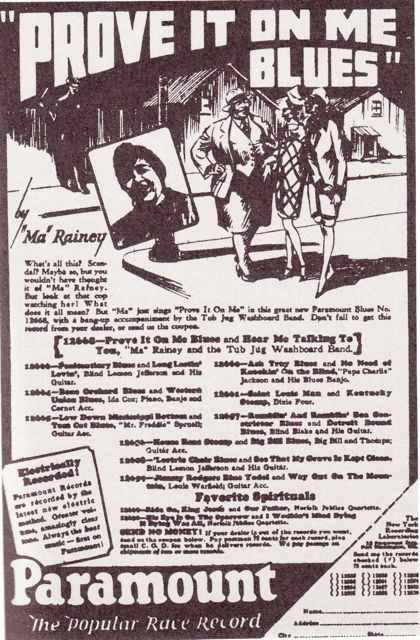
Following the separation from her husband, Ma Rainey went on to create her own show called “Madame Gertrude Rainey and Her Georgia Smart Set,” which gained popularity despite discrimination from the Theater Owners Booking Association (TOBA), which arranged performances for Black actors. However, she was a hit on the TOBA circuit (colloquially understood as “Tough on Black Artists”), attracting crowds of racially mixed attendees.
She was also notably bisexual and gender non-conforming in her outward expression. Though Ma Rainey remained married legally, she was known to have women as lovers. A well-known rumor holds that Ma Rainey and her close protege, Bessie Smith, “Empress of the Blues,” likely had a romantic relationship. Most of her songs that refer to sexuality depict relationships with men, but she also sang about her attraction to women. Her song, “Prove it on Me Blues,” discusses lesbianism and how she preferred female companionship and dressing masculine. “Went out last night with a crowd of my friends/ They must've been women, 'cause I don't like no men,” says Ma Rainey on the record.
This was incredible for 1928, a pre-Stonewall time when homosexuality was illegal. Angela Davis, feminist and political activist, has called her music a “precursor to the lesbian cultural movement of the 1970s.” In 1923, she signed with Paramount Records and became one of the first recorded blues musicians, joining a queer African-American art subculture that emerged in Harlem, New York, now known as the Harlem Renaissance of 1920 - 1935.
As the music industry became commercialized, corporate interests prioritized mainstream appeal and excluded art that did not speak to the white middle-class population. Ma Rainey and her contemporaries did not align with the traditional and puritanical taste of the emerging entertainment industry, and faded out of popularity from the 30s onwards.

Still, Ma Rainey’s art continues to outlast her era, and her work has not failed to inspire since. Before the blues became commercialized, before rock and roll, before mainstream pop, there was Ma Rainey’s soulful voice and mesmerizing stage presence. Many American popular music genres stem from the blues, and her work inspired musicians Bessie Smith, Louis Armstrong, poets Langston Hughes and Sterling Brown, and many more artists, musicians, and writers. For her legacy, we at We Make Noise honor and respect Ma Rainey as a catalytic figure for blues and American popular music as a whole.
Ongoing Inequities in Music
We reflect on Ma Rainey’s legacy to acknowledge how the music industry’s relationship with social and political factors continues to affect marginalized artists and industry professionals to this day. The music industry still excludes voices from underrepresented groups, namely women, gender-expansive, queer, and racialized groups.
Currently, the music industry is largely comprised of white men, especially in leadership positions. In a recent report, an analysis of major music companies revealed that 84.2% of leadership roles in top music companies were held by white men, leaving women, gender-expansive, and non-white professionals disproportionally underrepresented. When these creatives are not in the rooms sculpting the future of music, their knowledge, ideas, and perspectives are not considered, and exclusion pervades the industry.
Explicit and invisible barriers exist in the structure of the commercial music industry today in the form of biased hiring practices, unequal pay, and a lack of support for artists in marginalized communities. When these artists find success, they still face issues of appropriation, tokenization, and being pigeonholed into certain styles and genres.
How We Make Noise Is Changing the Industry
To combat these imbalances, We Make Noise harnesses the power of music and technology to advance global gender equity through our global network and programming. We develop our events and platforms to bring education, resources, and community directly to the hands of women and gender-expansive artists, and with over 20+ chapters worldwide, WMN supports local leaders equipping their communities with tools that cultivate limitless potential. Learn more about how we spread positive change in our most recent impact report.
As the music industry continues to evolve, We Make Noise strives to support future Ma Rainey's who will push the boundaries of today’s art and culture through their authentic expression.
Want to stay connected to stories like this?
Get firsthand experiences from inside the music industry, access opportunities, open calls, and updates on the work we do to make sure more women and gender-expansive artists are in the rooms where decisions are made.
Written by Ini Obong


Comments